In the middle of winter, I finally learned that there was in me an
invincible summer

Albert Camus

Some general interests. See my blog for more recent news and thoughts.

Global worming

I’m tired of all this back-slapping Isn’t-humanity-great bullshit. We’re a virus with shoes, OK? Bill Hicks

Like every species on a roll, we’re gobbling everything in sight until we are fighting and starving in our own effluent.

What really distinguishes homo rapiens off from, say, yeast, is that we’re talking about it.

Is there any way to avoid the planet shrugging us off?

Food of love

My favourite creation myth: God made humans just so he could listen to the music we make. Turns out nothing else – good, evil, whatever – matters. Just the music. Go play.

My current enthusiasm is for music from the Levant: gypsy music from the Balkans, arabesque pop from Turkey or rai from north Africa. The place to hear it is the annual Guča Trumpet Festival in Serbia. Particular favourites playing in Britain these days are Orkestra del Sol, The Baghdaddies and Paprika Balkanicus. See also Kazum! for events in London.

A longer-standing love is of early twentieth-century chamber music: Bartók, Kodály, Hindemith and Janaček. Kodály’s “Sonata for Unaccompanied ’Cello” Op. 8 and Hindemith’s “Sonata for Viola & Piano”, Op.11 N°4 are special favourites.

Late Junction on BBC Radio 3 is my best source of new music.

War on Terror

The “War on Terror” is a monstrous sham, a catch-all slogan spun onto the 9/11 attack and now available to justify domestic repression, violence abroad and to suppress debate. It is not a war, and has no achievable goals. It is a blank cheque for violence.

Do you love your country enough to see its faults? Under the ‘War on Terror’ we have illegally invaded Iraq and helped bring about a million deaths. We pretend to be ‘exporting’ a democracy we scarcely practise, when we are simply helping ourselves to the world’s most valuable commodity, oil. Remember, if Britain is a democracy, we are all accountable.

Readers to whom this sounds strange might find some history has escaped their attention. Here’s a sample.

Terror is a tactic used successfully by states and groups alike. (See the excellent paper “Terror’s Mask” by Michael Vlahos of the Joint Warfare Analysis Dept, Applied Physics Laboratory, Johns Hopkins University.) Its essence is violence to civilians; any weapon qualifies. Robespierre used guillotines against the French; Stalin, camps and firing squads against Russians. Germany fired V-bombs at the English; England used ‘area attack’ bombing to incinerate Hamburg and Dresden. America did the same to Hiroshima and Nagasaki with two atom bombs. Zionists used small arms against Palestinians in 1948; the Israeli Defence Force now uses planes, tanks and bulldozers. Palestinians use bombs against Israelis; the IRA used to do so against Londoners. And England tried bombing Kurds into becoming taxpayers.

The threat of terrorist attacks is as much terrorism as the attacks themselves. (Terrorism works by instilling terror.) Nuclear weapons are useful for little else; states that own them are ipso facto terrorist. That includes the United States, the United Kingdom, Russia, China, Israel, Pakistan, and India.

Nuclear-armed rogue states Who more flagrantly breaches the Nuclear Non-Proliferation Treaty: Iran or us? Iran, whose neighbours are either nuclear-armed (Russia and Pakistan) or occupied by nuclear-armed powers (Afghanistan and Iraq), looks like it might get into a position to produce nuclear weapons, but denies it will do so. In contrast, we have nuclear weapons, are in long-standing breach of our Treaty obligation to reduce or remove them, and instead have announced we shall get more – Trident. A nuclear-armed state with a history of terrorism – well, that would be us.

Art of the possible

Is democracy melting away with as little fuss as the polar ice? In what sense do people (demos) rule (-cracy) if political life reduces to occasional elections and a lot of comment? Can community be rebuilt in any other way than through local association?

The ancient Athenians were well aware of the danger to democracy from citizens who ignored public life and minded their families and their businesses, and they coined a term for them. They called these people idiots. Zakis Kounadis

I’m participating at The Heath and Hampstead Society, The Royal Society of Arts and OurKingdom.

Creole technology

Software production has got worryingly complicated, in large measure the result of applying standard strategies of industrialisation – divide and simplify – to what more often might be treated better as a craft.

In the vast workshop districts of Ghana, known as ‘magazines’, motor vehicles from the industrialised world have for decades been adapted and refitted for rugged African conditions. They can be maintained indefinitely in this new state, using only simple parts, a sophisticated improvisation that Edgerton calls ‘creolisation’. ‘At dusk,’ he writes, ‘bright intermittent light from welding illuminates streets all over the world, issuing from maintenance workshops which might also make simple equipment.’

From “A Place for Hype”, Edward Tenner’s review in the London Review of Books 10 May 2007 of The Shock of the Old: Technology and Global History Since 1900 by David Edgerton

Crafts are characterised by deep study and practise, small teams and relatively simple tools, well understood. The smartest programmers I know work alone and with a simple text editor and a OS console. What are the rest of us missing?

I edit Vector, the journal of the British APL Association, when I can get the damned thing printed; I also work as an evangelist for Dyalog.

Poetry and film

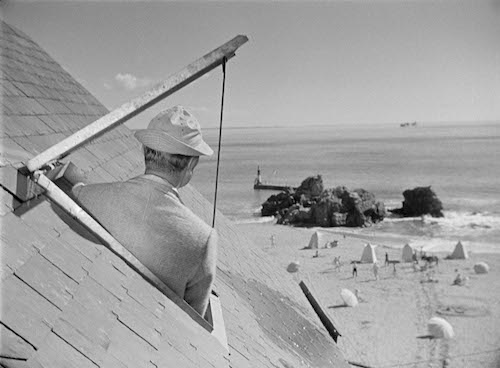
My two favourite media. My two favourite films are Jacques Tati’s Les Vacances de Monsieur Hulot and Aki Kaurismäki’s La vie de bohème.

Poetry is no more a vocation than good health is.
Boris Pasternak Dr Zhivago

I started writing poetry when I was 11 and haven’t stopped yet. Marilyn Hacker and Zbigniew Herbert were early influences; Geoffrey Hill and August Kleinzahler more recent ones.

I particularly admire Christopher Logue’s retelling of The Iliad. Recently I came across collections by New Yorker Kate Light, hard to find but worth looking out for.

5jt.com © 2003-13 Stephen Taylor
Permission to use quotes was neither sought nor obtained.

Valid HTML 4.01 Strict